Network Rail High Speed
If you’ve travelled on the UK’s only true high-speed railway, High Speed 1 (HS1), then you’ve travelled on tracks operated, maintained and renewed by us at Network Rail High Speed (NRHS).
We are a wholly owned subsidiary of Network Rail Infrastructure Ltd and have an agreement with our client London St Pancras Highspeed to manage their HS1 route infrastructure and three of their four stations: St. Pancras International, Stratford International and Ebbsfleet International.
Through our business model we work consistently to prove ourself as a quality provider to London St Pancras Highspeed, from reliability to value for money, and we work day in and day out to deliver on our vision, for everyone to love high speed rail.
Our people
We’re a team of over 500, working along the HS1 route in London and Kent. Our teams operate, maintain and renew HS1, working in roles across customer service, our station control rooms, our signalling centre, maintaining and renewing our railway infrastructure, safety specialists, engineers, and our finance and business support functions. We work around the clock to deliver high quality and reliable high speed rail in the UK.
Stay up to date with our latest news
Follow us on LinkedIn to receive the latest NRHS updates and news.
The HS1 rail line
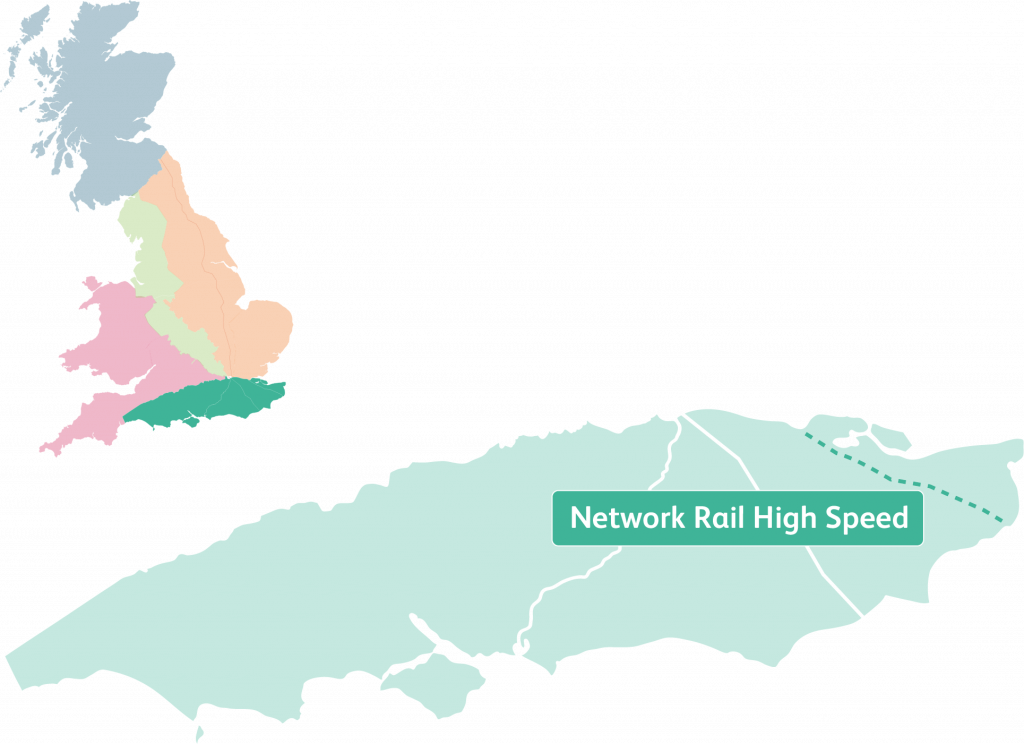
HS1 is a 109km rail line between St. Pancras International Station in London and the Channel Tunnel. The line supports high speed domestic routes from London throughout Kent, and international routes connecting London to Paris, Lille, Brussels and Amsterdam.
Our train operators
Our train operators are Eurostar and Southeastern which run on HS1 tracks, and we also have relationships with East Midlands Railway and Govia Thameslink Railway who access St. Pancras International Station, as well as freight companies GBRF and DB Cargo.
How we work
We operate to different standards to the rest of Network Rail, for instance we have our own safety management system and our own track safety qualification. We also do the majority of our maintenance and renewals work at night because the speed of the trains on HS1 make it unsafe to work while the line is open.
Safety
We work closely with our local communities to promote safety by the railway, including work on educating against and preventing trespass and promoting safe travel behaviours.
Projects
In April 2025, we entered our fourth five-year control period (CP4), which continues to see us focus on operating and maintaining the HS1 infrastructure and overseeing the planning and delivery of major renewal works and projects over CP4.
Although the HS1 infrastructure is still relatively new, the need for renewal works has increased in recent years as the asset ages.
Throughout CP4, we will continue to work closely with London St Pancras Highspeed, our train operating companies, and stakeholders to deliver renewals on the high speed line that minimise disruption for our passengers and keep trains running on time.
Supplier qualification requirements
If you supply goods, works or services under Railway Industry Commodity Classification List (RICCL) codes directly to Network Rail or Network Rail High Speed, or wish to do so, please be aware that both organisations use the Railway Safety and Standards Board (RSSB) Rail Industry Supplier Qualification Scheme (RISQS) as a Qualifying Utilities Dynamic Market (QUDM) under the Procurement Act 2023. We may choose to select suppliers directly from the QUDM without publishing a tender notice to the wider market. Suppliers of safety critical goods, works or services (i.e., RICCL codes) who wish to contract directly with us are asked to register on RISQS and obtain audited supplier status. We do not mandate that RISQS is applied through the supply chain – it remains the responsibility of the prime contractor to assure its own sub contractors and sub suppliers appropriately. If you supply goods, works or services under RICCL categories to buyers other than Network Rail or Network Rail High Speed, you should check with the relevant buying organisations to determine which supplier assurance system(s), if any, they use.