Sonning Cutting stabilisation work
We’re strengthening the slopes of Sonning Cutting near Reading for a safer, more resilient railway for passengers and freight services.
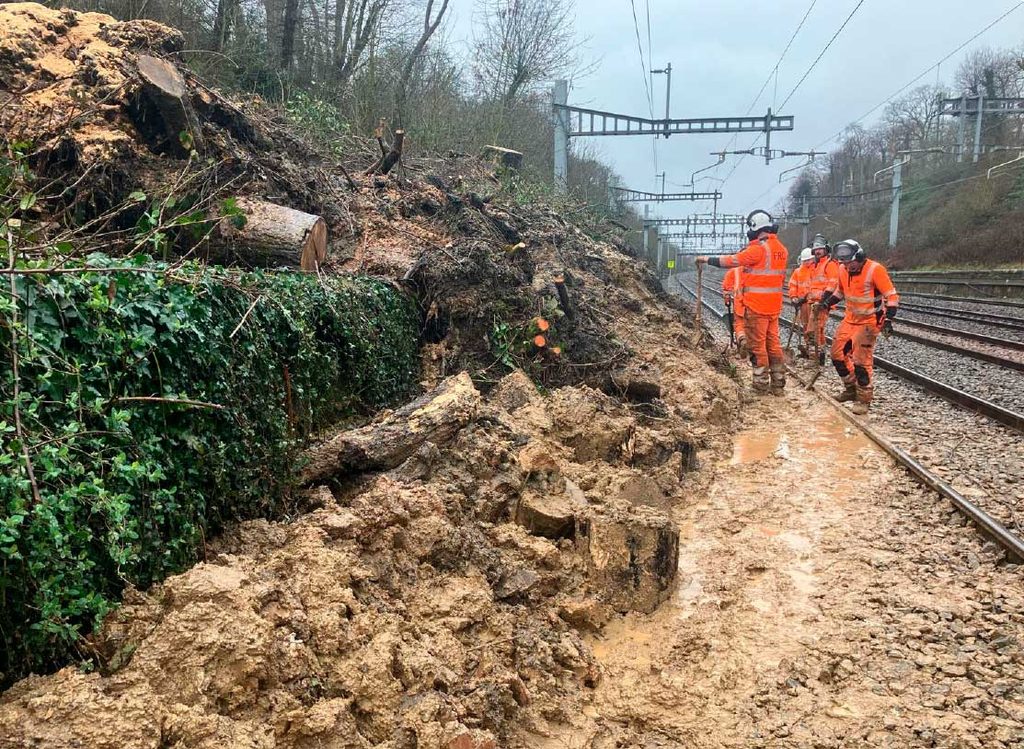
In recent years, several landslips have occurred at Sonning Cutting due to waterlogged ground conditions, including incidents in 2020 and 2024 which required emergency repairs.
The railway cutting dates back to the 1840s and, as the slopes continue to age and rainfall patterns become more intense, the need for long-term intervention has become increasingly important.
This essential work will stabilise more than one mile of susceptible railway cutting, providing a long-term solution that will help maintain the safe and reliable operation of this section of railway and reduce the need for future speed restrictions and emergency repairs.
We are committed to protecting and enhancing the environment, and we will carry out this work sensitively to reduce impact wherever possible.
Engineering solution
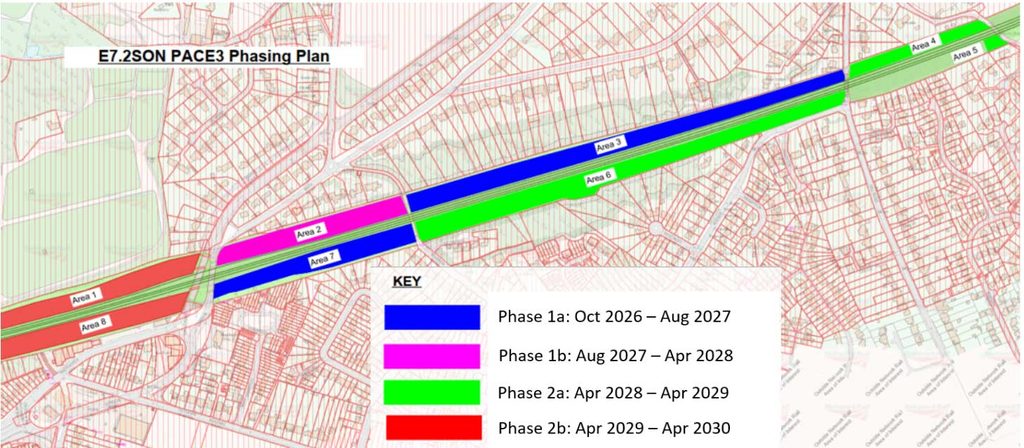
On 12 October 2026, a phased programme of work began that is expected to continue until approximately April 2030.
The first phase of work (Phase 1a), involves vegetation management within the railway boundary to create safe access to the cutting slopes and allow construction activities to take place.
Once access has been established, a combination of proven geotechnical engineering techniques will be used to strengthen and stabilise the slopes.
Phased delivery
The work has been carefully phased to minimise disruption and ensure safe delivery. Stabilisation activities will progress section by section along the cutting, allowing engineering teams to complete vegetation management, drainage improvements and slope reinforcement in a controlled and efficient manner.
This approach enables continuous environmental monitoring and ensures lessons learned from each section can be applied to subsequent phases.
Ecology and environmental protection
We are committed to protecting and enhancing the environment while delivering these essential railway improvements and are working in accordance with guidance from the Chartered Institute of Ecology and Environmental Management (CIEEM) and Natural England.
Ecological surveys completed in autumn 2025 and spring 2026 identified habitats and species requiring protection as well as areas capable of supporting protected species.
Specialist ecology consultants are supporting the project throughout design and construction to help ensure impacts on wildlife are minimised wherever possible. All activities are undertaken in line with environmental legislation and industry best practice.
The project team is also reviewing the engineering design to reduce impacts on trees and vegetation wherever possible while maintaining the safety and effectiveness of the stabilisation works.
Vegetation management is needed to gain safe access to the slopes and complete the soil nailing and drainage works required. Much of this activity will take place on Network Rail land.
Where vegetation management is required adjacent to the railway boundary, only the minimum amount of vegetation will be removed in order to safely carry out the work. If access to private land is required, affected landowners will be contacted well in advance.
To help protect wildlife, vegetation clearance has been programmed outside the main bird nesting season wherever possible. An Ecological Clerk of Works will inspect sensitive areas before work starts and ecological supervision will be provided where necessary.
Alongside nesting birds, measures are also being implemented to protect species such as bats and badgers where required.
Wherever possible, we are considering opportunities to provide environmental enhancements, including replacement planting and wider biodiversity improvements where appropriate.
Road closures
To ensure the safety of our workforce and the public, Warren Road fully closed on Monday 12 October 2026, with diversionary routes in place until approximately April 2028.
Butts Hill Road bridge will also close to vehicles from 9 November 2026 until 15 January 2027. Pedestrian access across the bridge will be maintained throughout this period.
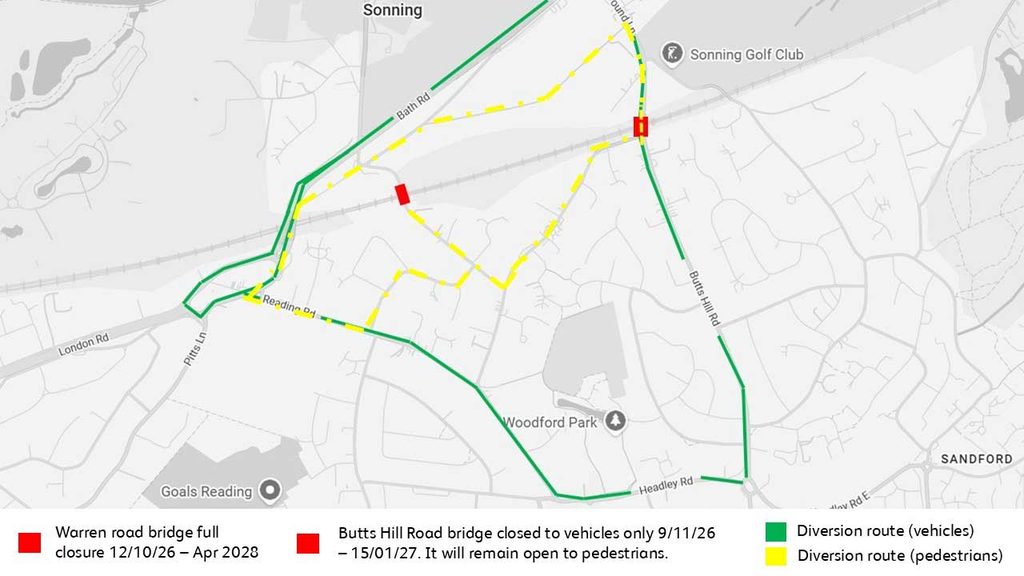
Vehicles will be diverted via London Road and Bath Road to cross the railway on the A4, using Headley Road and Reading Road on the Woodley side of the line.
Pedestrian access across Butts Hill Road Bridge will be maintained with signed diversion routes via Western Avenue and Reading Road to the south, and via Old Bath Road and West Drive to the north.